
Rear-End Collision Injuries: What Happens to Your Body When You’re Hit From Behind
Another car hits yours from behind, and your seat lurches forward with the car. It shoves your back and hips forward while your head, for a split second, stays where it was. Then your head catches up and snaps forward as the seat belt catches your chest. That sequence explains most rear-end collision injuries: strained necks and backs, stressed discs, jolted brains, and shoulders and wrists loaded by belts and bracing.
At Orthopedic Spine & Injury Center (OSIC), our physician-led team is 100% dedicated to accident injuries. Ada County alone recorded 2,401 injury crashes in 2025, according to the Idaho Transportation Department. If a driver hit you from behind on I-84 or a Meridian side street, you may be sorting through new aches right now. Knowing how the crash moved your body makes it easier to describe your symptoms (and to get the right care for them).
Table of Contents
- What Happens to Your Body When You’re Hit From Behind?
- What Are the Most Common Injuries From Being Rear-Ended?
- Why Does Your Back Hurt After Being Rear-Ended?
- Can a Rear-End Crash Cause a Concussion Without Hitting Your Head?
- How Do Seat Belts and Steering Wheels Cause Shoulder and Wrist Injuries?
- Can a Low-Speed Rear-End Collision Cause Injuries?
- Which Rear-End Collision Injury Symptoms Need Prompt Attention?
- How Does a Physician Pinpoint Your Injuries?
- Get Clarity After a Rear-End Collision
- Frequently Asked Questions
What Happens to Your Body When You’re Hit From Behind?
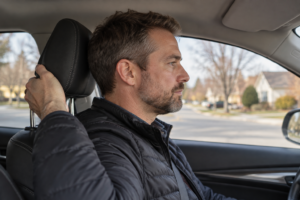
In a rear-end crash, your car lurches forward and the seat pushes your torso along with it. Your head lags for an instant, so your neck bends into an unnatural S-shape. Then your head whips forward as the seat belt stops your chest. Each phase strains a different part of your body, all within a fraction of a second.
- The push. The seat back drives into your middle and lower back, and your body can slide upward along the seat.
- The lag. Your shoulders move forward while your head stays put. Your lower neck bends backward as your upper neck bends forward, a curve the neck isn’t built to hold.
- The extension. If your head restraint sits too low or too far back, your head can tip backward over it and stretch the front of your neck.
- The rebound. Your head and torso snap forward, and the shoulder belt catches you across one shoulder and your chest.
None of this requires your head to hit anything, so you can leave a crash without a bruise and still have real tissue damage.
What Are the Most Common Injuries From Being Rear-Ended?
The most common rear-end collision injuries are neck sprains and strains, often called whiplash, along with back strains and disc injuries. Concussions, shoulder injuries from the seat belt, and wrist or hand injuries from bracing on the steering wheel also show up after these crashes. Many people have more than one.
| Injury | How a rear-end crash causes it | Symptoms you might notice |
|---|---|---|
| Neck sprain or strain (whiplash) | Your head lags behind, then whips forward | Neck pain and stiffness, headache at the base of the skull |
| Back strain or facet joint irritation | The seat back drives into your spine | Aching, stiffness, pain when bending or twisting |
| Disc injury | Sudden compression and bending of the spine | Pain that travels into an arm or leg, numbness, tingling |
| Concussion | The brain moves inside the skull during the back-and-forth motion | Headache, dizziness, fogginess, trouble concentrating |
| Shoulder injury | The shoulder belt loads one shoulder on the rebound | Pain lifting the arm, bruising along the belt line |
| Wrist or hand injury | Bracing on the steering wheel at impact | Wrist pain, swelling, weak grip |
Whiplash: The Classic Rear-End Injury
Whiplash is the rapid back-and-forth motion of the neck, and the name also covers the sprains and strains it causes. OrthoInfo, the American Academy of Orthopaedic Surgeons’ patient site, notes that doctors commonly see neck sprains after rear-end vehicle collisions and that pain can peak a day or so after the injury. Our page on whiplash injuries covers symptoms and care in more depth.
Why Does Your Back Hurt After Being Rear-Ended?

Back pain after being rear-ended usually starts with the seat back driving into your spine. That push can strain the muscles and ligaments of your back, irritate the small facet joints that link your vertebrae, or stress the discs that cushion them. If the injury reaches a nerve, the pain can travel into a leg.
Muscle and ligament injuries. A strain stretches or tears a muscle or tendon. A sprain injures a ligament, the tough band that connects bone to bone. Both can make sitting, bending, and lifting painful for weeks, as our article on back pain after a car accident explains.
Disc injuries. Discs are the rubbery cushions between your vertebrae. The sudden load of a crash can make a disc bulge or herniate, meaning its soft center pushes through the tougher outer ring. If that material presses on a nerve, the result is radiculopathy: pain, numbness, or tingling that travels into an arm from the neck or a leg from the lower back.
Can a Rear-End Crash Cause a Concussion Without Hitting Your Head?
Yes. A concussion can happen even if your head never touches the headrest or window. The CDC explains that a concussion can come from a hit to the body that causes the head and brain to move quickly back and forth, which is the motion of a rear-end crash.
Symptoms on the CDC’s concussion symptom list include headaches, dizziness or balance problems, feeling foggy or slowed down, trouble concentrating, sensitivity to light or noise, and sleeping more or less than usual. A neck injury can cause headache and dizziness too, so it takes an exam to sort out which is behind yours. We evaluate these symptoms through our brain injury and concussion care program.
How Do Seat Belts and Steering Wheels Cause Shoulder and Wrist Injuries?

The seat belt that holds you in place and the steering wheel you grip can both injure you. On the rebound, the diagonal shoulder belt catches one shoulder and your chest, which can bruise or strain that shoulder. If you saw the car coming in your mirror and braced on the wheel, the force can travel through your wrists, hands, and elbows.
Shoulder injuries. Belt loading can strain the rotator cuff, the muscles and tendons that hold your upper arm in its socket, or sprain the AC joint, where the collarbone meets the shoulder blade. Pain when you reach overhead or sleep on that side is a common sign of these shoulder injuries.
Wrist and hand injuries. Locked arms on the steering wheel send the jolt straight into your wrists. Ligament sprains, thumb injuries, and occasionally small-bone fractures can follow. OrthoInfo notes that a fracture of the scaphoid (a small wrist bone on the thumb side) can be mistaken for a sprain and may not show up on an X-ray right away. A wrist that stays swollen or loses grip strength deserves a look from a physician who treats elbow, wrist, and hand injuries.
Can a Low-Speed Rear-End Collision Cause Injuries?
Yes. A low-speed rear-end collision can still injure your neck, back, or other areas. The damage to your bumper doesn’t reliably tell you how much force reached your body. Your posture, the position of your head, and where your head restraint sat at impact can matter as much as speed.
The bumper explains part of why low-speed rear-end collision injuries surprise people. Carmakers design bumpers to resist damage in minor impacts. A bumper that doesn’t crumple absorbs less of the crash energy, so more of the jolt can pass through the frame and seat into you.
A few factors can raise the odds of injury in a slow crash:
- You had turned your head toward a mirror or a passenger.
- Your head restraint sat too low or too far behind your head.
- You had neck or back problems before the crash.
- A heavier vehicle, such as a pickup or SUV, hit you.
Rear-end accident injuries from slow crashes are a familiar part of stop-and-go traffic, from Eagle Road in Meridian to the I-84 interchanges in Nampa and Caldwell.
Which Rear-End Collision Injury Symptoms Need Prompt Attention?
See a physician promptly for pain that spreads into an arm or leg, numbness, tingling, weakness, headaches, dizziness, or neck and back pain that lingers or worsens over a day or two. A few symptoms are emergencies; those call for the nearest emergency room right away.
Go to an emergency room right away for:
- Severe neck pain after a hard impact, or neck pain with numbness or weakness in your arms or legs.
- A headache that gets worse and does not go away, repeated vomiting, slurred speech, confusion, or one pupil larger than the other.
- Loss of bladder or bowel control, or numbness in the groin and inner thighs.
- Belly pain, chest pain, trouble breathing, or bruising across your abdomen from the seat belt.
What to Do After Being Rear-Ended: Your Medical Next Steps
- Get evaluated soon. Schedule a physician’s evaluation even if your symptoms seem mild, and count symptoms that start a day or two later.
- Keep a symptom log. Note what hurts, when it started, and what makes it worse.
- Report every area that hurts. A sore wrist is easy to forget next to a stiff neck, and so is a knee that hit the dashboard.
Questions about fault or your claim belong with your attorney. Your personal injury lawyer is always the best source of any and all advice and information regarding your legal case.
How Does a Physician Pinpoint Your Injuries?
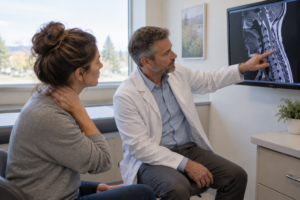
A physician pinpoints your injuries by pairing a hands-on exam with the right imaging. The exam checks your movement, strength, reflexes, and sensation to narrow down where the pain is coming from. Imaging then confirms it: X-rays show bones and alignment, while an MRI shows discs, ligaments, nerves, and other soft tissue.
Our full-service diagnostics include digital X-ray, MRI coordination, and EMG/NCS nerve testing. If your arm or leg has gone numb since the crash, two separate nerve tests can help find out why. A nerve conduction study (NCS) measures how fast and how strongly signals travel along a nerve. Electromyography (EMG) uses a thin needle electrode to record electrical activity inside a muscle, which can show whether the nerve supplying that muscle works normally.
What Treatment Usually Looks Like
Our physicians treat most rear-end collision injuries without surgery. Surgery is usually the last resort; for most patients, physical therapy, chiropractic care, and pain management come first, and surgery enters the conversation only after those options are exhausted. After your evaluation, we arrange those referrals or coordinate with a chiropractor or physical therapist you already see.
Through coordinated specialty care, our spine, orthopedic, and brain injury specialists review your neck, back, shoulder, and head symptoms together, under medical director Dr. Phil Davidson, a board-certified orthopedic surgeon with more than twenty years’ experience treating injury patients. That integrated, patient-centered approach keeps you from shuttling between offices, and our concierge support team handles the scheduling.
Get Clarity After a Rear-End Collision

Maybe the other driver’s bumper barely shows a scratch, and your neck still won’t turn far enough to check your blind spot. Relax. Breathe. From Boise and Meridian to Nampa and Caldwell, a physician’s evaluation can show what the crash did and lay out a plan to help you get back to your life.
Our Idaho clinic is on East Gentry Way in Meridian, and we schedule same-day appointments for urgent injuries whenever possible. We work on a lien or letter-of-protection basis, so there may be no out-of-pocket treatment options for qualifying injury cases. When you’re ready to get clarity about your condition and next steps, request an appointment. Live outside Idaho? We also treat accident patients at our Utah, Washington, and Vancouver–Portland area clinics.
Frequently Asked Questions
Can you get hurt in a low-speed rear-end collision?
Yes. Even a slow rear-end collision can strain your neck or back, especially if you had turned your head or your head restraint sat too low. Light bumper damage doesn’t mean light forces on your body. Pain, stiffness, or headaches after a minor crash are worth a physician’s evaluation.
What are the symptoms of rear-end collision injuries?
Common symptoms include neck pain and stiffness, headaches at the base of the skull, back pain, and pain that travels into an arm or leg. Numbness, tingling, dizziness, trouble concentrating, shoulder pain, and wrist swelling can also appear. Some symptoms start hours or a day after the crash, so keep track of anything new.
Do I need an MRI after being rear-ended?
Not always. Your physician decides based on your exam. An MRI shows discs, ligaments, nerves, and other soft tissue that X-rays can’t, so it often comes into play when pain travels into an arm or leg, numbness or weakness appears, or symptoms don’t improve with early care.
Should I see a doctor after being rear-ended if I feel okay?
It’s a good idea. Neck sprains and concussions can take hours or a day to show symptoms, and mild pain can hide a more serious injury. An exam gives you a clear picture of your condition, a record of any injuries, and a plan if you need treatment.