

Do You Need an Orthopedic Doctor After a Car Accident?
An emergency room answers one question after a crash: is anything life-threatening? Once the answer is no, you go home with a discharge sheet that reads something like “cervical strain, follow up with your doctor.” It often doesn’t say which doctor. For injuries to the bones, joints, ligaments, and spine, a car accident orthopedic doctor is often the right next call, since orthopedic training covers the parts of the body a collision loads hardest.
Plenty of people in the Treasure Valley face that choice. Ada County recorded 7,420 crashes and 3,325 people injured in 2025, according to the Idaho Transportation Department’s annual crash report. At Orthopedic Spine & Injury Center (OSIC), we treat accident injuries and nothing else. OSIC is physician-led, and our medical director, Dr. Phil Davidson, is a board-certified orthopedic surgeon with more than twenty years’ experience treating injury patients. Many crash patients see more than one kind of doctor, and knowing where an orthopedist fits makes the rest easier to sort out.
Table of Contents
- What Does a Car Accident Orthopedic Doctor Treat?
- 6 Signs That Point to an Orthopedic Evaluation
- Orthopedic Doctor vs. ER vs. Primary Care After a Car Accident
- What Happens at Your First Orthopedic Visit After a Car Accident
- Does Seeing an Orthopedic Doctor Mean You’ll Need Surgery?
- When to Schedule an Orthopedic Visit After a Crash
- Get Answers From OSIC’s Orthopedic Team in Meridian
- Frequently Asked Questions
What Does a Car Accident Orthopedic Doctor Treat?
A car accident orthopedic doctor diagnoses and treats injuries to the musculoskeletal system: bones, joints, ligaments, tendons, muscles, and the spine. After a crash, that usually means neck and back injuries, shoulder and knee damage, wrist and hand injuries from bracing, and fractures. The orthopedic physician also directs the imaging and therapy that follow.
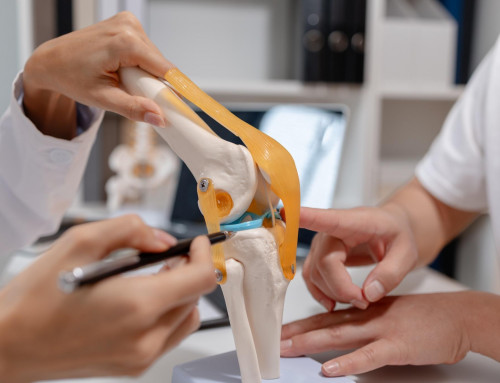
The American Academy of Orthopaedic Surgeons describes orthopaedic surgeons as medical doctors with about 14 years of formal education who focus on disorders of the bones, joints, ligaments, tendons, and muscles. A collision strains all of those structures in a fraction of a second. Crash injuries that fall in an orthopedist’s lane include:
- Neck sprains and strains. Whiplash stretches or tears the ligaments and muscles of the neck when your head snaps forward and back.
- Disc injuries. A herniated disc is a spinal disc whose soft center pushes through its tougher outer ring, where it can press on a nearby nerve.
- Shoulder injuries. Bracing against the steering wheel or striking the door can strain or tear the rotator cuff, the group of muscles and tendons that keeps the upper arm bone centered in the shoulder socket.
- Knee injuries. A bent knee hitting the dashboard is a classic way to tear the posterior cruciate ligament (PCL), the ligament at the back of the knee that keeps the shinbone from sliding backward. Our knee injury page covers the range of crash-related knee damage.
- Wrist, hand, and bone fractures. Gripping the wheel at impact can sprain or break the wrist, and a hard enough hit can fracture an arm, rib, or leg.
6 Signs That Point to an Orthopedic Evaluation
See an orthopedic doctor after a car accident if you have neck or back pain that worsens with movement, pain that spreads into an arm or leg, numbness or weakness, a joint that swells or gives way, lost range of motion, or pain that isn’t improving after a week or two. A proper evaluation is how you learn the cause.
- Neck or back pain that worsens when you move. Stiffness that tightens as you turn your head or bend over is typical of a sprain or strain. According to OrthoInfo, neck sprain pain may not start until hours after the injury, or even the next day.
- Pain that travels. Pain running from your neck into your shoulder blade or arm, or from your low back into your buttock or leg, can mean an irritated or compressed nerve.
- Numbness, tingling, or weakness. Pins and needles in your hands or feet, or a grip that feels weaker than it did last week, can signal nerve involvement that deserves testing. Weakness that comes on suddenly or keeps getting worse belongs in the ER section below.
- A joint that swells, catches, or gives way. A knee that buckles on the stairs or a shoulder that clicks and aches can have ligament, cartilage, or tendon damage.
- Lost range of motion. Trouble lifting your arm overhead, fully straightening your knee, or turning your head to check your blind spot while merging onto I-84 all call for a closer look.
- Pain that isn’t improving. Most neck sprain symptoms go away in 4 to 6 weeks, the same OrthoInfo page reports. Pain that holds steady or gets worse over the first week or two is a reason to get checked instead of waiting out that window.
When to Go to the ER Instead
Some symptoms need emergency care first. Call 911 or go to the nearest emergency room if you have:
- Loss of consciousness, confusion, slurred speech, repeated vomiting, or a headache that keeps getting worse
- Trouble breathing, severe chest or abdominal pain, or seat-belt bruising across your abdomen
- A limb that looks deformed or a bone that has broken through the skin
- Sudden or rapidly worsening weakness or numbness in your arms or legs, or numbness in the groin or inner thighs
- New loss of bladder or bowel control
Once you’re stable, an orthopedic follow-up picks up where the ER left off.
Orthopedic Doctor vs. ER vs. Primary Care After a Car Accident
The emergency room stabilizes you and rules out life-threatening injuries. Your primary care doctor manages your overall health and can refer you on. An orthopedic doctor focuses on the bone, joint, ligament, and spine injuries a crash leaves behind and builds the treatment plan that follows. Many accident patients see more than one.
| Provider | Main job after a crash | Typical tools | When it fits |
|---|---|---|---|
| Emergency room | Find and treat emergencies such as head injuries, internal injuries, and fractures | X-ray, CT scan, stabilizing care | Right away, when symptoms are severe |
| Primary care doctor | Check your overall health, manage medication, make referrals | Physical exam, basic imaging orders | Mild symptoms and an established doctor |
| Orthopedic doctor | Diagnose and treat musculoskeletal and spine injuries, then manage recovery | Focused exam, X-ray, MRI, nerve testing, a treatment plan | Pain, weakness, or joint problems that persist or need a specialist |
An ER X-ray tells you whether a bone is broken. It can’t show a torn ligament or a herniated disc, since X-rays don’t show soft tissue clearly. An MRI is the test that shows discs, ligaments, and tendons, so a physician orders one when the exam points to soft-tissue damage. Primary care doctors handle a wide range of problems, and many refer a persistent joint or spine injury to a specialist anyway. Going to an orthopedic physician directly can shorten that path.
When Another Specialist Fits Better
An orthopedist isn’t the answer for every post-crash symptom. Headaches, light sensitivity, trouble concentrating, or memory gaps point toward a possible concussion, which calls for a brain injury evaluation. Our brain injury and concussion care program and neurology team treat those injuries inside the same coordinated plan, so a patient with a neck sprain and a concussion works with one team instead of juggling two referrals.
What Happens at Your First Orthopedic Visit After a Car Accident
Your first orthopedic visit after a car accident starts with the details of the crash and your symptoms, followed by a hands-on exam of your spine and injured joints. Your OSIC physician decides whether you need imaging or nerve testing, then explains the findings and the treatment plan. You should leave with a clear picture of what’s injured.

If you’re nervous about the appointment, that’s normal. Our physicians walk you through each step, and you can ask questions at any point.
- The crash history. Expect questions about the direction of impact, where you were sitting, whether you wore a seatbelt, and when each symptom started. Those details help our physicians predict which structures took the load.
- The physical exam. Your physician checks range of motion, strength, reflexes, and sensation, then presses on or moves specific joints to find the source of the pain.
- Diagnostics when warranted. X-rays rule out fractures. An MRI shows discs, ligaments, and tendons. EMG/NCS testing is short for electromyography and nerve conduction studies. EMG records the electrical activity in your muscles, and nerve conduction studies measure how well and how fast your nerves carry signals. OSIC’s full-service diagnostics include digital X-ray and EMG/NCS testing, and our team coordinates MRI and CT scans with affiliate imaging centers and radiology partners.
- A plan and a record. Your physician explains the diagnosis and the next steps, and every finding goes into your medical record. From there, our concierge support team schedules and coordinates the imaging, therapy, and specialist visits in your plan, so you aren’t managing them alone.
What to Bring to Your Appointment
- Discharge papers from the ER or urgent care, plus any imaging discs or reports
- The police report number and your auto insurance claim number
- A list of your current medications
- A short symptom log: what hurts, when it started, and what makes it worse
- Your personal injury attorney’s contact information, if you have one
- Completed new patient forms
Does Seeing an Orthopedic Doctor Mean You’ll Need Surgery?
No. Seeing an orthopedic doctor after a car accident does not mean you’re headed for surgery. Many crash injuries, including most neck sprains, improve with conservative care such as physical therapy, chiropractic care, and pain management. At OSIC, surgery is usually the last resort, discussed for most patients only after non-surgical treatment has had a fair chance to work.

The OrthoInfo guide to orthopaedics states that seeing an orthopaedic surgeon does not necessarily mean you will end up having surgery. For soft-tissue and spine injuries, a conservative-first plan coordinated by OSIC may include:
- Physical therapy by referral to rebuild strength and range of motion
- Chiropractic care by referral for spinal mobility, coordinated with your physician
- Pain management, including medication or targeted injections when pain blocks your progress
For most patients, our team exhausts these options before starting discussions regarding surgery. Exceptions include an unstable or displaced fracture, which the ER often finds and stabilizes first, and nerve compression causing weakness that is getting worse, which needs prompt evaluation. If worry about an operation is what’s keeping you from booking, that order should help.
When an Auto Accident Orthopedic Surgeon Gets Involved
Surgery enters the conversation in specific situations: an unstable or displaced fracture, some complete tendon or ligament tears, nerve compression causing weakness that keeps getting worse, or pain that persists after conservative care has run its course. In those cases, an auto accident orthopedic surgeon on the same team reviews your imaging and history, so you don’t start over with a stranger. OSIC’s team includes spine surgery and orthopedic extremity surgery alongside non-surgical spine care.
When to Schedule an Orthopedic Visit After a Crash
Book an orthopedic evaluation within a few days of the crash if you notice any of the first five signs above, and sooner if pain is severe or spreading or weakness is getting worse. If your symptoms started mild, the sixth sign is your checkpoint: pain that isn’t easing after a week or two means it’s time to get evaluated.
Waiting is common. Adrenaline, a busy work week, or the hope that soreness will fade can stretch days into weeks. If it’s been a few weeks, that’s okay. We start from where you are today. If you have a personal-injury claim, ask your attorney how the timing of care affects it. Your personal injury lawyer is always the best source of any and all advice and information regarding your legal case.
Get Answers From OSIC’s Orthopedic Team in Meridian
If you were hurt in a crash anywhere in the Boise Metro area, our Meridian clinic can help you get clarity about your condition and next steps. Led by Dr. Davidson, our team is 100% dedicated to accident injuries, and the same concierge staff that coordinates your plan will help you get your first visit on the calendar.

For qualifying injury cases, OSIC works on a lien or letter-of-protection basis, and there may be no out-of-pocket treatment options while your case is pending. Learn more about our car accident injury care, then request an appointment or call 208-278-2300. Our Idaho clinic is at 3080 East Gentry Way, Suite 200, Meridian, ID 83642, and serves patients from Boise, Nampa, Caldwell, and communities across the state. Same-day appointments are available for urgent injuries whenever possible. Outside Idaho? We also have clinics in Utah, Washington, and the Vancouver–Portland metro. Find the one nearest you on our locations page.
Frequently Asked Questions
Should I see a car accident orthopedic doctor or a chiropractor first?
For most crash injuries, start with a physician evaluation. A car accident orthopedic doctor can examine your spine and joints, order imaging when the exam calls for it, and check for fractures, disc injuries, or nerve problems before anyone adjusts your spine. If chiropractic care fits your plan, our team coordinates it by referral, so your chiropractor and your physician work from the same findings.
Can I keep seeing my current chiropractor or physical therapist?
Yes, in many cases. If you already see a chiropractor or physical therapist you trust, our team can coordinate your care with that provider so you don’t have to start over. Your OSIC physician reviews your progress and adjusts the plan as you heal. If you don’t have a provider yet, we refer you to one and keep track of how therapy is going.
What should I ask my orthopedic doctor after a car accident?
Ask what your exam and imaging show and what the diagnosis means for your daily life. Then ask which activities to avoid while you heal and which new symptoms mean you should call before your next visit. Write your questions down beforehand, since appointments move fast. Our physicians expect questions and will explain each answer in plain language.
How long does it take to recover from a car accident injury?
Recovery time depends on the injury. Most neck sprain symptoms go away in 4 to 6 weeks, according to OrthoInfo, while disc injuries, ligament tears, and fractures often take longer. Your OSIC physician gives you an expected timeline based on your exam and imaging, then updates it as you progress. An evaluation is the way to know what your own recovery may look like.
Will my orthopedic records matter for my personal injury claim?
They often do. Your orthopedic records document what was injured and how you are responding to treatment, and your attorney decides how to use them in your case. When a case calls for it, our medical-legal team also provides Medical Legal Evaluations. Your personal injury lawyer is always the best source of any and all advice and information regarding your legal case.